Why Is My Moka Pot Leaking? 6 Causes and Simple Fixes
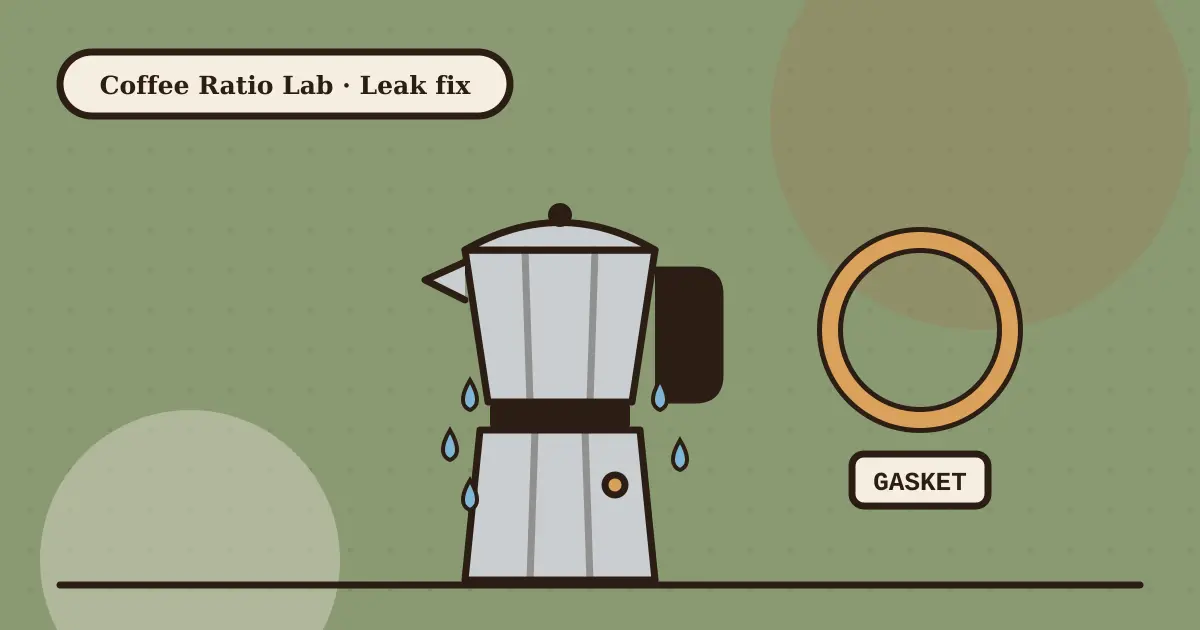
Most moka pots leak at the middle joint because of coffee grounds on the rim, a worn or hardened rubber gasket, or the two halves not being screwed tightly. Water escaping from the safety valve usually means too much pressure — grind too fine, coffee tamped, or water filled above the valve. Clean the rim, replace the gasket and fill correctly to fix most leaks.
A leaking moka pot is annoying and can be dangerous — hot water and steam escaping around the middle of a pot on a flame. The good news: almost every leak has a simple cause, and where the leak happens tells you which one.
Step 1: Find where it's leaking
Before changing anything, brew once with the lid open and watch carefully (use a dish towel and keep your face clear).
| Where you see water or steam | Most likely cause | Jump to |
|---|---|---|
| Around the middle joint, early in the brew | Grounds on the rim, not tight, worn gasket | Causes 1–3 |
| Around the middle joint, only near the end | Pressure building up — grind too fine or tamped | Cause 4 |
| From the safety valve | Too much pressure, or water above the valve | Causes 4–5 |
| From the base itself (seam, crack) | Damaged or corroded boiler | Cause 6 |
| Coffee seems to "leak" into the boiler afterward | Normal backflow when cooling | See FAQ |
Cause 1: Coffee grounds on the rim
This is the most common reason and the easiest to fix. A few grains of coffee sitting on the rim of the basket or the top of the boiler stop the gasket from sealing evenly. Steam finds the gap.
Fix: after filling the basket, run a finger or a dry pastry brush around the rim of the basket and the top edge of the boiler. It takes three seconds and solves a large share of leaks.
Cause 2: Not screwed tightly enough
The two halves need firm contact. Many people under-tighten because the boiler is hot (if you used preheated water).
Fix: hold the boiler with a folded dish towel or oven glove and screw the top on firmly. Don't use the handle as a lever — handles on aluminum pots can loosen or snap. Firm hand-tight is enough; excessive force flattens the gasket faster.
Cause 3: Worn, hardened or wrong-size gasket
The rubber or silicone gasket on the underside of the top chamber is a wear part. Heat makes it harden, shrink and crack over time. A gasket that looks shiny, feels hard or has a visible groove no longer seals.
Fix: replace it. Here's how:
- Unscrew the top chamber and turn it upside down.
- Pull out the filter plate and gasket — a butter knife or small flathead screwdriver helps (go gently on aluminum).
- Clean the groove thoroughly; old coffee residue there causes leaks even with a new gasket.
- Push in the new gasket, then the filter plate on top, pressing evenly all round.
- Brew a pot with cheap coffee and discard it to break in the new gasket.
Getting the right size: gaskets are sized by pot model and cup size. Use the replacement made for your exact model where possible. If you buy a generic one, measure the outer diameter of the old gasket and match it closely. Silicone gaskets usually last longer than natural rubber, and many people find them easier to fit.
How often? Regular daily users often need a new gasket every 6–12 months. Keep a spare.
Cause 4: Too much pressure
A moka pot is designed to work at fairly low pressure. If the water can't get through the coffee easily, pressure keeps rising until steam forces its way out of the weakest point — the middle joint or the safety valve.
Things that cause this:
- Coffee ground too fine (espresso-fine or finer)
- Coffee tamped or pressed down in the basket
- Basket overfilled into a mound
- Very high heat, which builds pressure faster than the coffee can flow
Fix: grind slightly coarser than espresso (see our grind size chart), fill the basket level without pressing, and use medium heat.
Cause 5: Water filled above the safety valve
If water covers the valve, the valve can't release pressure properly, and water may spit out of it.
Fix: fill only to just below the valve. Many boilers have a line inside; if not, use the bottom edge of the valve as your maximum.
Cause 6: A damaged boiler
Cheap or very old aluminum pots can develop pitting corrosion or hairline cracks, especially around the base seam or the valve housing. Dropping a pot can also warp the threads so the halves no longer meet evenly.
Fix: inspect the threads — if they're flattened or cross-threaded, the pot won't seal reliably. If water leaks from the body itself, stop using it. A cracked boiler is a safety risk under pressure; replace the pot.
Safety valve check (do this every few months)
The safety valve is your pot's protection against excessive pressure. Mineral deposits can make it stick.
- With the pot empty and cool, gently press the small pin in the valve (on many models you can push it from the inside).
- It should move freely. If it's stuck, soak the boiler in a mild descaling solution and rinse well — see how to clean a moka pot.
- Never block, tape or cover the valve.
A leak-free routine
- Hot water to just below the valve.
- Level, untamped basket of moka-grind coffee.
- Brush the rims.
- Screw firmly, holding the boiler with a towel.
- Medium heat, lid open, remove at the first gurgle.
Frequently asked questions
Why does my moka pot leak from the middle?
Usually grounds on the rim, a loose connection, or a worn gasket. Clean the rims, tighten firmly and replace the gasket if it's hard or cracked.
Why is steam coming out of my moka pot's valve?
Pressure inside is too high. Use a coarser grind, don't tamp, don't overfill the basket or boiler, and lower the heat. If the valve releases steam every brew, check it isn't clogged with limescale.
How do I know if my moka pot gasket needs replacing?
If it feels hard, looks flattened or cracked, or the pot leaks at the joint even when clean and tight, replace it.
Why does coffee go back into the bottom chamber?
As the boiler cools, the pressure drops and a little coffee can be drawn back down. This is normal. Pour the coffee out soon after brewing to avoid it.
Liked this guide? Get the next one free
Subscribe and get our free printable Brew Cheat Sheet — every ratio, grind and temperature on one page. Then one practical brewing tip a week. No spam, unsubscribe anytime.

We write step-by-step guides for everyday home brewers: moka pots, French presses, AeroPress, pour over and cold brew. Every guide is checked against manufacturer instructions and widely accepted brewing guidance, and updated when we learn something better. How we write our guides.