Coffee Grind Size Chart: Every Brew Method Compared to Kitchen Ingredients
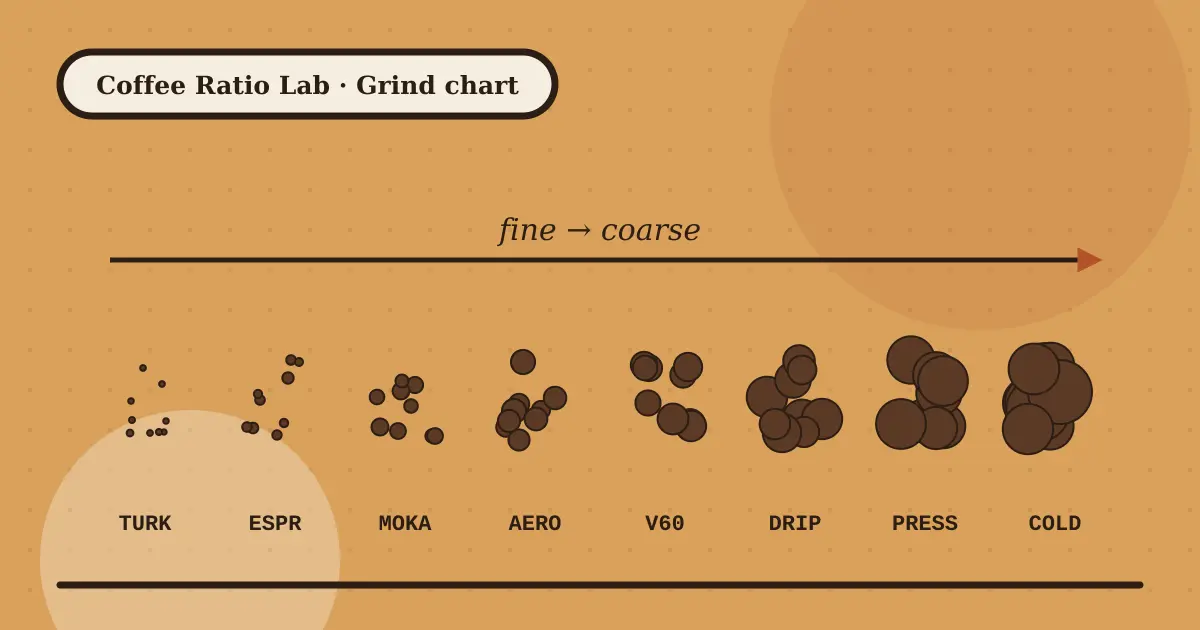
Use extra fine for Turkish, fine for espresso, fine to medium-fine for moka pot, medium-fine for AeroPress, medium for pour over and drip, coarse for French press and extra coarse for cold brew. Adjust by taste: sour means grind finer, bitter means grind coarser.
Grind size controls how fast water extracts flavor from coffee. Get it wrong and the same beans can taste sour, bitter, weak or harsh. This chart shows the usual grind for every popular brew method, using things you already have in your kitchen as a reference.
The chart
| Brew method | Grind name | Looks like | Approx. particle size |
|---|---|---|---|
| Turkish coffee | Extra fine | Flour or powdered sugar | 100–200 µm |
| Espresso | Fine | Fine powder, slightly gritty | 200–400 µm |
| Moka pot | Fine–medium-fine | Table salt | 350–650 µm |
| AeroPress | Medium-fine | Fine sand | 350–800 µm |
| Pour over (cone) | Medium | Granulated sugar | 450–850 µm |
| Drip coffee maker | Medium | Coarse sand | 600–900 µm |
| French press | Coarse | Sea salt | 700–1,200 µm |
| Cold brew | Extra coarse | Cracked peppercorns | 900–1,600 µm |
The micron (µm) figures are broad, approximate ranges compiled from common guidance. Real grinders produce a spread of sizes, and every grinder labels its settings differently. Use the chart as a starting point, then adjust by taste.
Why grind size matters so much
Smaller particles have more surface area, so water extracts them faster. That's why each method needs a different grind:
- Short contact time (espresso: about 25–35 seconds) needs a fine grind to extract enough flavor quickly.
- Long contact time (French press: 4 minutes; cold brew: many hours) needs a coarse grind so it doesn't over-extract.
- Filters matter too: metal mesh lets fine particles through, so French press needs a coarse grind to stay clean.
How to tell if your grind is wrong
| Taste | Meaning | Change |
|---|---|---|
| Sour, sharp, thin, salty | Under-extracted | Grind finer |
| Bitter, dry, harsh, hollow | Over-extracted | Grind coarser |
| Sweet, balanced, clear | About right | Keep it |
Other clues:
- Pour over drains very slowly → too fine.
- Espresso gushes out in under 15 seconds → too coarse; grind finer.
- French press is hard to plunge → too fine.
- Moka pot spurts violently → often heat, but sometimes too fine.
Adjusting in small steps
Change one thing at a time. Move your grinder one or two steps, brew again with the same ratio and water temperature, and taste. Keep notes: date, beans, grind setting, ratio, and what you liked. After a few brews you'll know your grinder's sweet spot for each method.
Pre-ground coffee: which to buy
If you don't own a grinder:
- "Espresso" grind suits espresso machines and also works in a moka pot (just don't tamp).
- "Filter" or "drip" grind suits drip machines, pour over and AeroPress.
- "Cafetière" or "French press" grind is the coarsest you'll usually find.
Pre-ground coffee loses aroma within days of opening, so buy small bags and store them well — see how to store coffee beans.
Grind and ratio work together
A grind that's slightly off can be balanced a little with the ratio, and vice versa. Start with the recommended ratio for your method using our coffee ratio calculator, then fine-tune the grind. Water temperature matters too — see our coffee water temperature chart, and adjust for roast with our light vs dark roast guide.
Frequently asked questions
What grind size is best for a moka pot?
Fine to medium-fine, about the texture of table salt — slightly coarser than espresso.
What grind should I use for drip coffee?
Medium, similar to coarse sand. Flat-bottom drip baskets usually like it a touch coarser than cone filters.
Is espresso grind too fine for pour over?
Yes. It will clog the filter, drain very slowly and taste bitter.
Why does my grinder setting not match the chart?
Grinder scales differ between brands and models. Start in the middle of the recommended range and adjust by taste.
Liked this guide? Get the next one free
Subscribe and get our free printable Brew Cheat Sheet — every ratio, grind and temperature on one page. Then one practical brewing tip a week. No spam, unsubscribe anytime.

We write step-by-step guides for everyday home brewers: moka pots, French presses, AeroPress, pour over and cold brew. Every guide is checked against manufacturer instructions and widely accepted brewing guidance, and updated when we learn something better. How we write our guides.