Arabica vs Robusta: Taste, Caffeine and What's Really in Your Coffee Bag
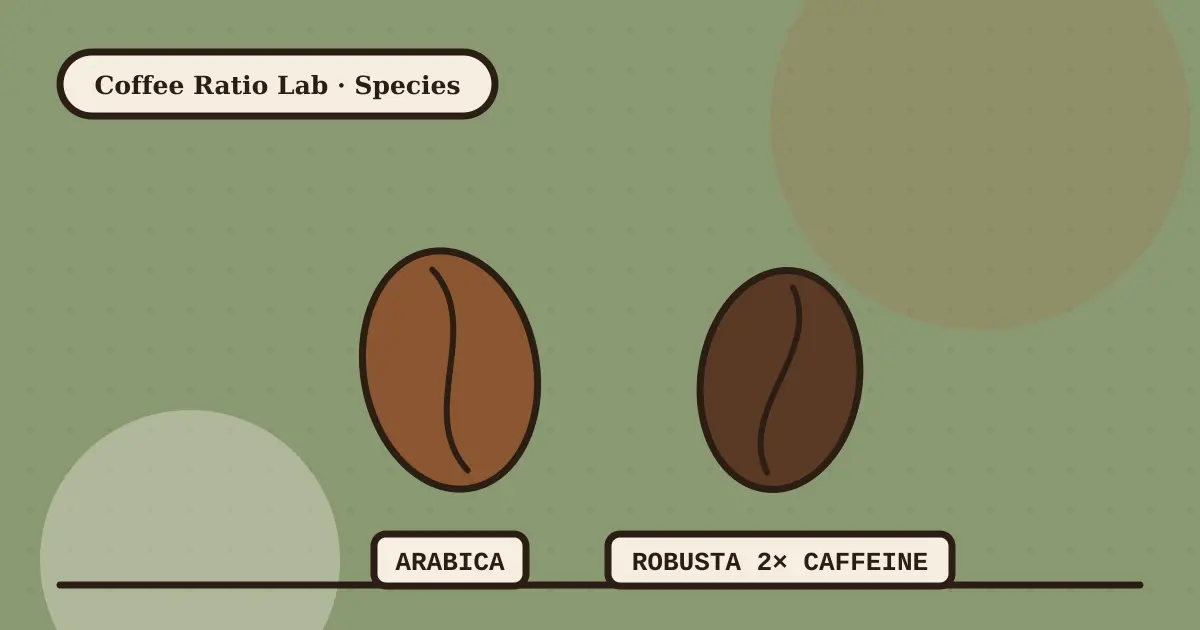
Arabica tastes sweeter and more complex, with more acidity and fruit or chocolate notes, and makes up the larger share of world coffee. Robusta tastes stronger, more bitter and earthy, contains roughly twice as much caffeine, and is hardier and cheaper to grow. Robusta is common in instant coffee and Italian-style espresso blends, where it adds body and crema.
Most coffee you'll ever drink comes from two species of the coffee plant: Coffea arabica and Coffea canephora, better known as Robusta. They look similar as roasted beans, but they taste different, grow differently and end up in different products.
Quick comparison
| Arabica | Robusta | |
|---|---|---|
| Flavor | Sweeter, more acidity, fruit, floral, chocolate, caramel | Stronger, more bitter, earthy, woody, nutty |
| Caffeine (by weight of beans) | ~1–1.5% | ~2–2.7% (roughly double) |
| Sugar & lipid content | Higher | Lower |
| Growing altitude | Higher (often 1,000–2,000 m+) | Lower, hotter areas |
| Plant hardiness | More delicate, more disease-prone | Hardier, more pest-resistant, higher yield |
| Price | Higher | Lower |
| Share of world production | Larger share (roughly 55–60%) | Smaller share (roughly 40–45%) |
| Bean shape | Oval, curved center line | Rounder, straighter center line |
| Typical uses | Specialty coffee, filter, most espresso | Instant coffee, many espresso blends, budget blends |
Figures are approximate and vary by variety, region and year.
Why Robusta has more caffeine
Caffeine is a natural pest deterrent. Robusta grows in hotter, lower regions with more insect pressure, and its higher caffeine is part of why it's hardier. That extra caffeine also adds bitterness.
Taste in the cup
Arabica is valued for complexity: depending on origin and processing it can taste like berries, citrus, jasmine, milk chocolate or caramel. Most specialty coffee is Arabica.
Robusta has a heavier body and stronger, more bitter taste. Low-grade Robusta can taste rubbery or harsh; carefully grown and processed "fine Robusta" can be pleasantly chocolatey and nutty.
Robusta and espresso crema
Robusta produces more crema — the golden foam on espresso — and adds body that cuts through milk. That's why many traditional Italian espresso blends include a proportion of Robusta. If you love a thick crema and a punchy cappuccino, a blend with some Robusta may suit you.
How to read a coffee bag
| Label says | What it usually means |
|---|---|
| "100% Arabica" | No Robusta; a common quality claim, but not a guarantee of freshness or great taste |
| "Espresso blend" | May contain Robusta — check the ingredients |
| "Arabica/Robusta blend 80/20" | Mostly Arabica with some Robusta for body and crema |
| "Fine Robusta" | Higher-quality Robusta, carefully processed |
| No species listed (cheap blends, instant) | Often contains Robusta |
Freshness matters as much as species — check the roast date and see how to store coffee beans.
Which should you buy?
| You want… | Choose |
|---|---|
| Fruity, bright, nuanced black coffee | 100% Arabica, light–medium roast |
| Classic Italian-style espresso with thick crema | Arabica blend with some Robusta |
| Maximum caffeine kick | Robusta or a high-Robusta blend |
| Strong coffee for milk drinks | Medium-dark blend, possibly with Robusta |
| Lowest cost | Robusta-heavy blends |
Brewing tips
- Robusta-heavy coffee can taste harsh in pour over. It shines in moka pots, espresso and with milk.
- Arabica suits every method; lighter roasts are best in pour over and AeroPress.
- If a blend tastes too bitter, try cooler water — see the water temperature chart — or our Fix My Coffee tool.
Frequently asked questions
Does Robusta have more caffeine than Arabica?
Yes, roughly twice as much by weight.
Is Arabica better than Robusta?
Arabica is generally considered higher quality for flavor, but good Robusta has its place, especially in espresso blends.
Is instant coffee Robusta?
Much instant coffee contains Robusta because it's cheaper and gives a strong flavor, though some instant coffees are 100% Arabica.
Which has more antioxidants?
Robusta generally contains more chlorogenic acids, a group of antioxidant compounds that also contribute to its bitterness.
- Espresso tonic — Scandinavia
- Freddo espresso — Greece
- Greek frappé — Thessaloniki, Greece
- Irish coffee — Foynes, Ireland
Liked this guide? Get the next one free
Subscribe and get our free printable Brew Cheat Sheet — every ratio, grind and temperature on one page. Then one practical brewing tip a week. No spam, unsubscribe anytime.

We write step-by-step guides for everyday home brewers: moka pots, French presses, AeroPress, pour over and cold brew. Every guide is checked against manufacturer instructions and widely accepted brewing guidance, and updated when we learn something better. How we write our guides.